Project overview
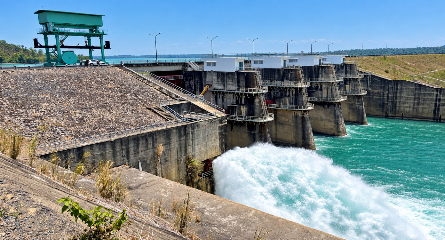
Designed capacity of 280 MW from 2 units, located on the Srepok River cascade about 350 km from Ho Chi Minh City.
Buon Kuop is arguably the most geologically complex hydropower project in Vietnam, mainly beneath the main dam and at the spillway abutments. PSC has worked on the project from its earliest stage to the present day.
Main components of Buon Kuop Hydropower Plant
- Reservoir: catchment area 7,980 km²; total storage 73.78 million m³; active storage 25.63 million m³.
- Main dam: earth dam, 34 m high, 1,828 m long.
- Spillway: bottom energy dissipation, bays of 15 × 16 m.
- Intake: 2 gates, 8 × 7.2 m.
- Headrace tunnels: reinforced concrete, diameter about 7.0–6.0–5.0 m, length 2 × 4,326 m.
- Surge tank: reinforced concrete, diameter 19/3.8 m, height 130 m.
- Powerhouse: 2 Francis units, 2 × 140 MW, rated head 98.5 m.
- Switchyard: outdoor, 220/110 kV.
Challenges and our long-term involvement
PSC took part in surveys, studies and design across many stages, from feasibility and pre-feasibility studies to technical design, tender documents, construction drawings and designer’s supervision. The terrain is rugged and dissected: the site lies on a plateau along the Srepok River valley with slopes of varying dissection. The project has thick overburden, highly weathered basalt or residual soils, and loose soil and rock with low strength that are sensitive to changes in moisture.
Reaching survey locations, setting up boreholes and moving machinery were very difficult because of rain and landslides. Maintaining the accuracy of the survey control network required flexible, well-suited and creative field planning – where PSC’s local field knowledge proved its true value.
During construction, however, a slope failure occurred at the right abutment of the spillway. It was attributed to the heterogeneity and unusual fracturing of the actual geology revealed after excavation, which surveys at the technical design stage had not detected or predicted. PSC and PECC2 promptly carried out supplementary geological investigations to develop suitable solutions.
A collapse also occurred in the headrace tunnel during construction; once again, PSC’s geologists and the design engineers went to the site to assess it and propose timely remedial solutions.
PSC remained a responsible partner throughout construction until the plant entered service.
It should be noted that the conventional survey methods used for the technical design could not reveal the full complexity of the natural geology, especially minor folds and unusual changes in the attitude of soil and rock layers in the geological structure of the right spillway abutment slope.
Seepage treatment and lessons learned
During operation, to treat seepage through the main dam foundation and abutments (porous basalt with interconnected cavities), PSC carried out investigation drilling to analyse and assess engineering geological conditions, then proposed grouting to create a continuous grout curtain. PSC carried out the anti-seepage grouting for the dam. Check drilling showed that grouting significantly reduced seepage through the dam, and verification calculations confirmed that the remaining seepage through the foundation and abutments does not affect the dam’s stability.
At Buon Kuop, PSC gained many lessons in landslide treatment and dam foundation seepage control, which have been distilled into practical guidance for projects with similar geological conditions.
For Srepok 3 Hydropower Plant, survey work for design was also carried out on a very tight schedule, and with the geological lessons from Buon Kuop, PSC’s geologists took extra care in assessing the foundation and abutment conditions.
After Buon Kuop, PSC was entrusted with Srepok 3 – its second hydropower project on the Srepok River.
Results and capabilities demonstrated
This case study is proof of PSC’s disciplined and responsible commitment throughout the asset lifecycle – which is why PSC has again been entrusted with the next phase: the Buon Kuop Hydropower Expansion in 2026.